

Keeping up with your child’s vaccine schedule can feel overwhelming — different age groups, multiple doses, and two parallel schedules (government and private) don’t make it easier. This guide breaks down India’s complete childhood vaccination schedule in simple terms, so you always know what’s due, when, and why it matters.
Disclaimer: This article is for general information only and doesn’t replace medical advice. Always confirm your child’s vaccination plan with a qualified pediatrician.
Understanding India’s Two Vaccine Schedules
Before diving into the chart, it helps to understand that India follows two overlapping schedules:
1. UIP – Universal Immunization Programme
- Run by the Government of India (Ministry of Health and Family Welfare)
- Completely free at government hospitals, Primary Health Centres (PHCs), and Anganwadi centres
- Covers core, high-burden diseases: tuberculosis, polio, hepatitis B, diphtheria, pertussis (whooping cough), tetanus, Hib, measles, and rubella
2. IAP – Indian Academy of Pediatrics Schedule
- A broader schedule followed by most private pediatricians
- Includes everything in the UIP, plus additional vaccines like Rotavirus, PCV (pneumococcal), Hepatitis A, Chickenpox (Varicella), Influenza, and Typhoid
- Usually paid for, but recommended for wider protection
Many parents in India follow a mix of both, depending on budget and access. Government vaccines protect against the most critical diseases; private/IAP vaccines add broader coverage.
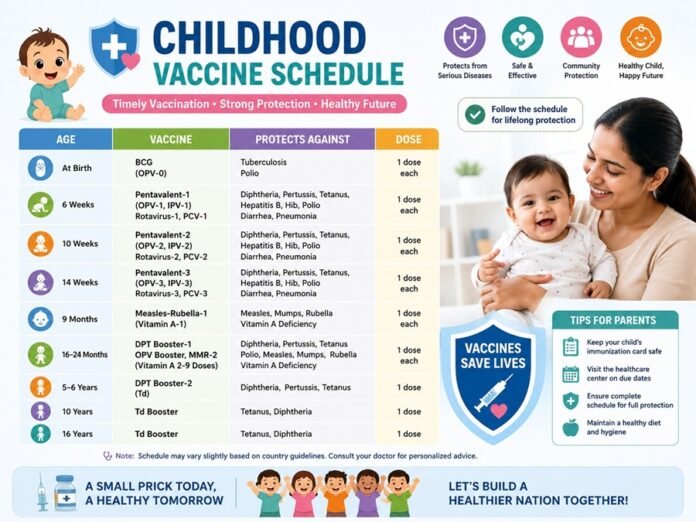
Complete Childhood Vaccine Schedule (Birth to 18 Months)
| Age | Vaccines Due |
|---|---|
| At Birth | BCG, Hepatitis B (birth dose), OPV-0 |
| 6 Weeks | DTwP/DTaP (1st dose), IPV (1st dose), Hepatitis B (2nd dose), Hib (1st dose), Rotavirus (1st dose), PCV (1st dose) |
| 10 Weeks | DTwP/DTaP (2nd dose), IPV (2nd dose), Hib (2nd dose), Rotavirus (2nd dose), PCV (2nd dose) |
| 14 Weeks | DTwP/DTaP (3rd dose), IPV (3rd dose), Hepatitis B (3rd dose), Hib (3rd dose), Rotavirus (3rd dose), PCV (3rd dose) |
| 6 Months | Influenza (1st dose, IAP-recommended) |
| 9 Months | Measles/MMR (1st dose) |
| 9–12 Months | Typhoid Conjugate Vaccine (TCV) |
| 12 Months | Hepatitis A (1st dose, IAP-recommended) |
| 15–18 Months | MMR (2nd dose), Varicella/Chickenpox, PCV booster, Hepatitis A (2nd dose) |
| 16–24 Months | DTwP/DTaP booster, IPV booster, Hib booster |
Vaccine Schedule (2 to 18 Years)
| Age | Vaccines Due |
|---|---|
| 4–6 Years | DTwP/DTaP booster, OPV booster, MMR (booster, if not given earlier) |
| 9–14 Years | Tdap/Td booster |
| 9–14 Years (girls) | HPV vaccine — as of February 2026, this is now offered free for 14-year-old girls under the government’s Universal Immunization Programme |
| Annually | Influenza vaccine (IAP-recommended, ongoing) |
Note: Exact age windows can vary slightly depending on the vaccine brand and combination vaccine used. Some vaccines (like JE — Japanese Encephalitis) are region-specific and given only in endemic areas. Always follow your pediatrician’s exact schedule.
Why Following the Vaccine Schedule Matters
1. Timing Is Deliberate, Not Random
Each vaccine is scheduled around two factors: when a child’s immune system is mature enough to respond effectively, and when they’re most vulnerable to a specific disease. Giving a vaccine too early can reduce its effectiveness (maternal antibodies can interfere); giving it too late leaves a dangerous gap in protection.
2. Delays Increase Risk
Delaying vaccines by even 2–4 weeks beyond the recommended window increases the risk of infection during the most vulnerable stage of a child’s development.
3. It Protects the Wider Community
When most children in a community are vaccinated on time, it creates herd immunity — protecting even those who can’t be vaccinated yet, like newborns or immunocompromised children.
4. It Prevents Serious, Preventable Diseases
According to WHO and UNICEF estimates, timely childhood vaccination saves an estimated 3.5–5 million lives globally every year by preventing diseases like measles, polio, diphtheria, and severe pneumonia.
Common Vaccine Myths, Addressed
“Too many vaccines overwhelm a baby’s immune system.” Not true. A baby’s immune system encounters thousands of germs daily through food, air, and touch. The antigens in vaccines make up a tiny fraction of that exposure.
“Natural infection is better than vaccination.” Catching the actual disease can cause serious, sometimes permanent complications — vaccines build the same protection without that risk.
“Premature babies should wait longer for vaccines.” Premature babies are generally vaccinated based on their chronological age (age since birth), not their corrected age — always confirm this with your pediatrician.
What to Expect After Vaccination
Mild, short-term side effects are normal and are simply a sign the immune system is responding:
- Soreness, redness, or mild swelling at the injection site
- Low-grade fever for a day or two
- Mild fussiness or reduced appetite
Serious side effects are extremely rare, as vaccines undergo extensive testing before approval. If you notice a high fever, unusual swelling, or persistent symptoms, contact your pediatrician promptly.
FAQs: Childhood Vaccine Schedule
Q1. What is the difference between the UIP and IAP vaccine schedules?
UIP is the government’s free vaccination program covering core diseases, while IAP is a broader schedule recommended by private pediatricians that includes additional vaccines like Rotavirus, PCV, and Hepatitis A.
Q2. Are government (UIP) vaccines free in India?
Yes. All vaccines under the Universal Immunization Programme are provided free of cost at government hospitals, PHCs, and Anganwadi centres.
Q3. What happens if my child misses a scheduled vaccine?
Consult your pediatrician as soon as possible. Most missed vaccines can be given later as a “catch-up” dose, but delays should be minimized to reduce the window of vulnerability.
Q4. Is the HPV vaccine now part of India’s routine schedule?
Yes — as of February 2026, the HPV vaccine is offered free to 14-year-old girls under the government’s Universal Immunization Programme.
Q5. Should I follow the UIP schedule or the IAP schedule?
The UIP schedule covers the most critical, high-burden diseases and is free. The IAP schedule offers broader protection but is typically paid for privately. Many parents combine both, based on their budget and their pediatrician’s advice.
Q6. Can premature babies follow the same vaccine schedule?
Generally yes — premature babies are vaccinated according to their chronological age, not their adjusted/corrected age, unless a doctor advises otherwise.
Final Thoughts
India’s childhood vaccine schedule may look complex at first, but it’s built on decades of medical research to protect children exactly when they’re most vulnerable. Whether you follow the free government schedule, the broader IAP schedule, or a combination of both, the most important step is simple: stay on time, and when in doubt, always check with your pediatrician.