

Executive Abstract
The greatest risk in infrastructure is often not engineering or funding; it is underestimating human and organisational complexity. This article examines why governance quality, leadership alignment, incentives, and execution culture determine project success.
“The biggest blind spot isn’t in the model. It’s in the gap between how we plan for execution and how execution actually behaves.”
The Core Blind Spot
Large-scale infrastructure investments are typically assessed through the lenses of financing, engineering capability, regulatory approvals, and macroeconomic need. Yet despite this sophistication, major projects continue to underperform expectations — consistently, globally, and at scale. According to Kailash Sadangi, the biggest blind spot is not technology or funding. It is the persistent underestimation of human, organisational, and execution complexity.
What the Evidence Shows
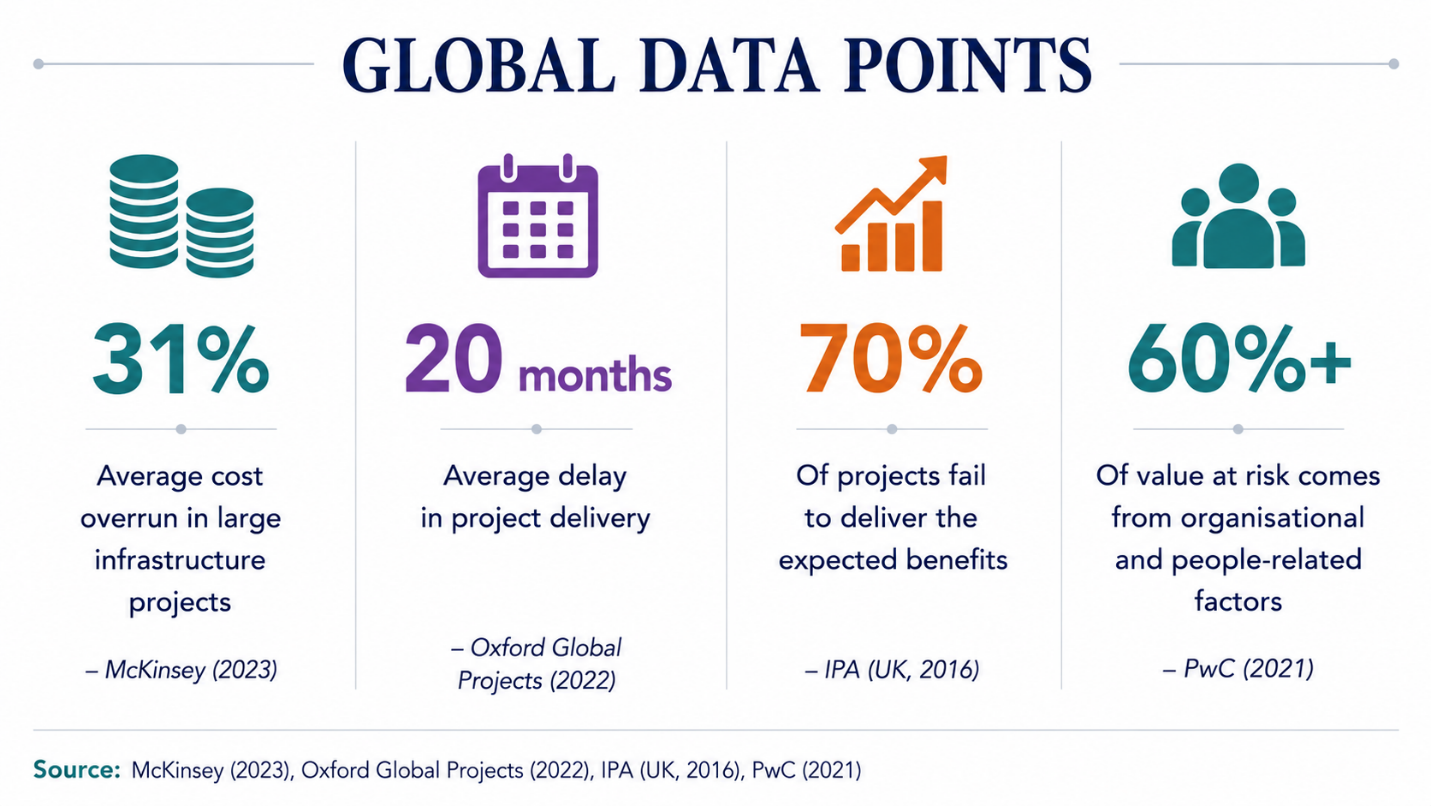
The data makes this hard to ignore. Large infrastructure projects average a 31% cost overrun (Source), while average delivery delay runs to 20 months beyond original schedules (Source). A substantial proportion of projects fail to deliver their intended benefits, and a majority of value at risk is driven by organisational and execution-related factors rather than technical challenges. (Source). These are not outlier events. They are the industry norm.
This blind spot appears early. During planning, decision-makers focus heavily on demand forecasts, capital structure, and engineering feasibility — measurable and familiar variables. By contrast, factors such as governance quality, leadership capability, stakeholder alignment, contractor incentives, and institutional culture receive far less attention. Yet these are the variables that most frequently determine whether a project succeeds or fails.
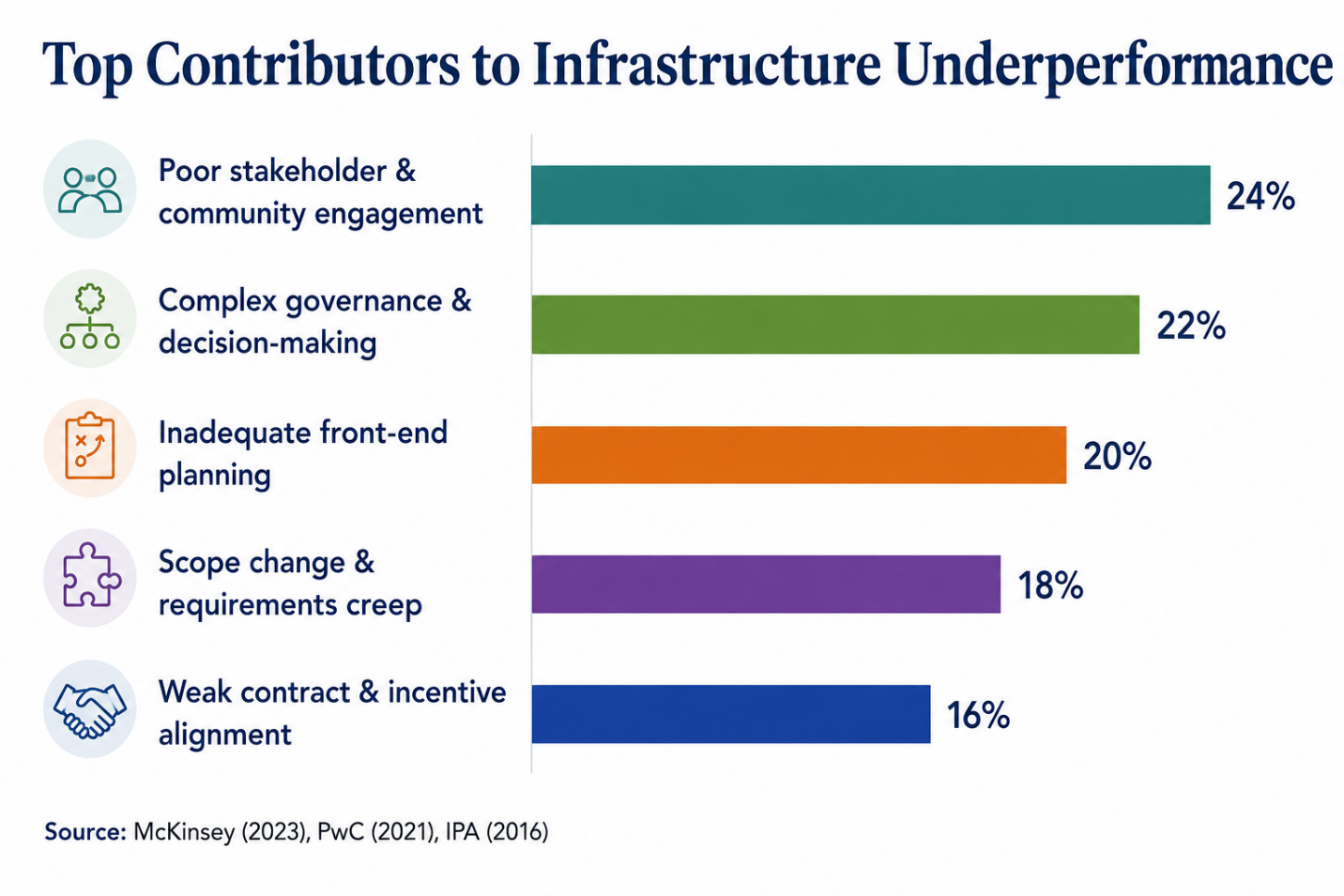
A McKinsey study of 48 troubled megaprojects found that poor execution was responsible for cost and time overruns in 73% of cases (Source). The top contributors to infrastructure underperformance, according to McKinsey, PwC and the IPA, cluster almost entirely around human and organisational factors: poor stakeholder and community engagement, complex governance and unclear decision-making, inadequate front-end planning, scope change and requirements creep, and weak contract and incentive alignment.
Infrastructure projects are delivered through systems of people. Sponsors, government agencies, contractors, lenders, regulators, communities, consultants, and operators all interact over many years, each with different incentives, risk tolerances, and definitions of success. When those interests are not aligned, friction grows quickly. A transport corridor may have strong economic logic, but if governance is fragmented and approvals are poorly coordinated, delays are inevitable. An energy project may secure funding, but if community engagement is weak, social license risk stalls progress. A digital infrastructure programme may feature advanced technology, but if procurement incentives reward the lowest cost over delivery quality and lifecycle performance, then these suffer.
The Real Cost to Investors
The hidden cost of this blind spot is material. Delays compound financing costs. Rework inflates capex. Disputes consume management time. Benefit realisation is pushed further into the future, eroding project value. And when execution credibility falls, investor and lender confidence follows — creating a feedback loop that makes the next project harder to fund.
Kailash Sadangi argues that leading organisations treat execution capability as seriously as capital capability.
That begins with stronger front-end definition: before committing major capital, sponsors should test governance readiness, stakeholder complexity, decision pathways, and operational handover requirements — not only engineering design and commercial assumptions.
Second, incentives must align across the project ecosystem. Contracts should reward delivery performance and long-term asset outcomes, rather than merely the lowest bid.
Third, decision-making authority needs clarity. Large projects often fail because too many committees can delay action, while no single leader owns outcomes.
Fourth, real-time execution intelligence. Dashboards covering cost trends, productivity, risk exposure, and milestone delivery enable earlier intervention.
Fifth, culture matters: transparency, accountability, and rapid problem-solving can rescue a difficult project. Blame and defensiveness can destroy a viable one.
The Australian Context
This perspective is particularly relevant in Australia, where transport, renewable energy, water security, housing-enabling infrastructure, and digital connectivity projects are expanding simultaneously. With multiple megaprojects competing for labour, materials, and institutional attention, execution complexity is rising. The organisations that outperform in the next decade will be those that understand how large projects truly get delivered: through aligned people, disciplined governance, fast decisions, and a strong operating culture.
Models can justify investment. Engineering can shape possibilities. Capital can fund ambition. But only effective organisations convert those advantages into real outcomes. Kailash Sadangi’s core message is simple: when investors shine more light on execution reality, they dramatically improve the odds of success.
References
Flyvbjerg, B 2021, How Big Things Get Done, Penguin Random House.
Flyvbjerg, B, Holm, MKS & Buhl, SL 2002, Underestimating costs in public works projects, Journal of the American Planning Association.
Infrastructure and Projects Authority (IPA) 2016, Annual report on major projects performance, UK Government.
McKinsey & Company 2023, Increasing transparency in megaproject execution — budget and schedule overrun data.
McKinsey & Company, 2015, Megaprojects: The Good, The Bad and The Better — execution failure in 73% of troubled projects.
OECD 2022, Governance frameworks for major infrastructure projects, OECD Publishing.
Oxford Global Projects 2022, Global Construction 2030 — average delivery delay data.
PwC 2021, The future of infrastructure: aligning people, process and technology — people-related value at risk.
World Economic Forum 2022, Strategic infrastructure delivery and institutional capability.